Homelessness is not just about lacking a roof over your head. It’s about isolation, exclusion, and the absence of a place to belong.
During Homeless World Cup 2025, Mel Young (President and Co-Founder, Homeless World Cup), Evelyn Dyb (Researcher at NIBR and OsloMet), Homeless World Cup player Gabrielle and Carl Thodesen (Pro-Rector for Social Improvement and Collaboration at OsloMet, Chair of the Board at Punkt Oslo), gathered to discuss one of society’s most persistent challenges - homelessness. While the number of people experiencing homelessness has decreased in some areas, it remains a pressing issue — including in Norway.
Homelessness Has Many Faces
The conversation began with a reflection on how homelessness can be defined. It quickly became clear that there is no universal definition. What it means to be homeless varies greatly from country to country, and even within communities.
In Norway, people are considered homeless if they do not have access to their own owned or rented residence and are referred to temporary and unstable housing arrangements. Such temporary housing arrangements include staying with friends, acquaintances, or relatives, being in an institution or under the correctional services and scheduled for discharge/release within two months without having a home.
– Homelessness and houselessness are not the same, one speaker noted. Giving someone a house doesn’t necessarily solve the problem. A house is not a home.
The panel emphasized that feeling at home is about more than shelter. It’s about acceptance, connection, and community — themes that echoed throughout the week’s events.
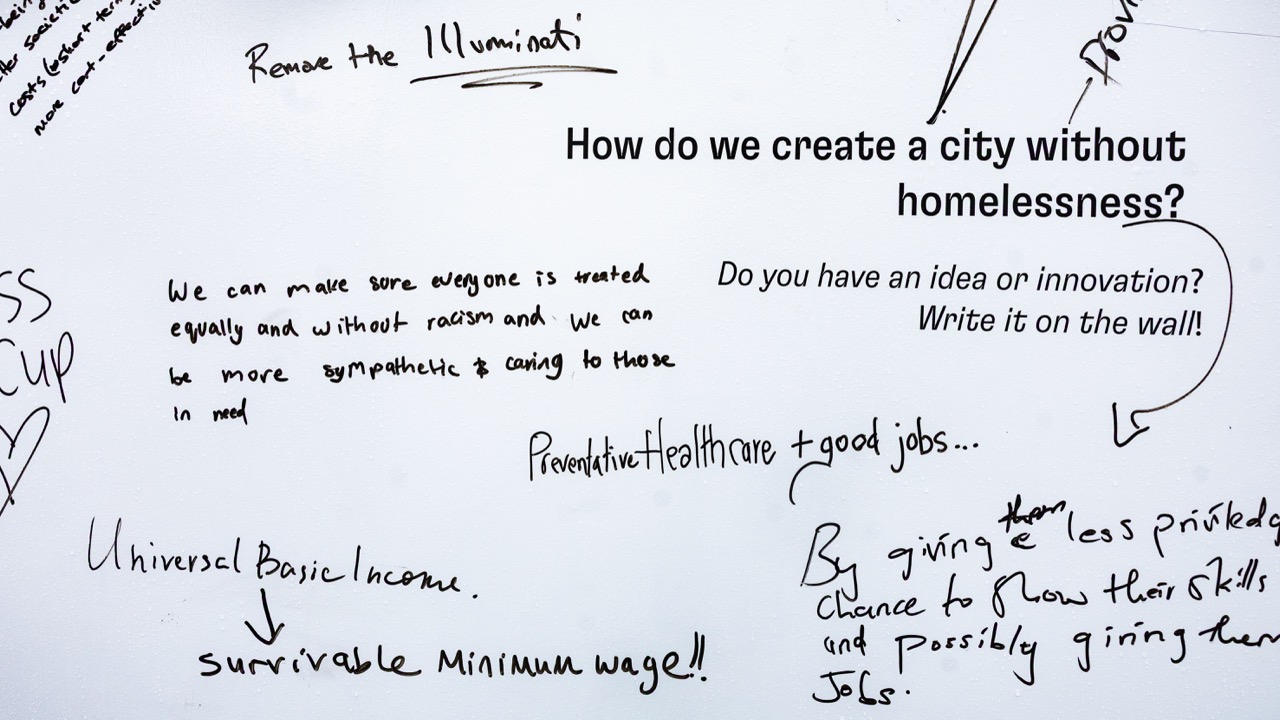
Where Do We Start?
When asked how we begin to end homelessness, Evelyn offered a candid perspective:
– I’m sceptical about the idea of having a zero-goal approach to ending homelessness. She pointed out that focusing too narrowly on the goal of ending homelessness can lead to policies that push people out of sight, rather than supporting them.
Not everyone wants a home when it’s offered. Sometimes, society just wants to hide homelessness — to clean up the streets. That’s dangerous.
Mel offered a counterpoint: – We should still aim for that goal. We need safety nets, and we need to include people instead of excluding them. Football is one of the most powerful tools we have — it’s a common language. It creates family, connection, and responsibility.
Gabrielle the Homeless World Cup player added: – Even if you have a home, there’s always something that can go wrong between the four walls. Ending homelessness might not be possible, but football has helped her to find a family and feel less alone.
Beyond statistics
The conversation also entailed a discussion of how to study and work towards ending homelessness. While statistics are important — especially for influencing political decisions — they shouldn’t be used to dismiss other forms of knowledge and experience. Mel emphasized that ending homelessness requires more than housing — it demands a shift in societal attitudes and political priorities.
– We need to change how we think about homelessness. We need policies that support inclusion, not just management.
In Norway, public perception has shifted. Where people once believed homelessness didn’t exist, there’s now a growing awareness of its many forms — including invisible homelessness and those in “in-between” situations.
The panel agreed that homelessness is deeply diverse. It’s not just about poverty or addiction. It’s about trauma, disconnection, and the systems that fail to catch people when they fall.
A Common Language
Football, music, and community were highlighted as tools for healing and connection. Gabrielle shared her experience:
– Playing street football isn’t about winning or losing. It’s about being part of something. It’s about knowing someone is there for you.
Way ahead
The panel didn’t offer easy answers — but it raised essential questions for future discussion: